
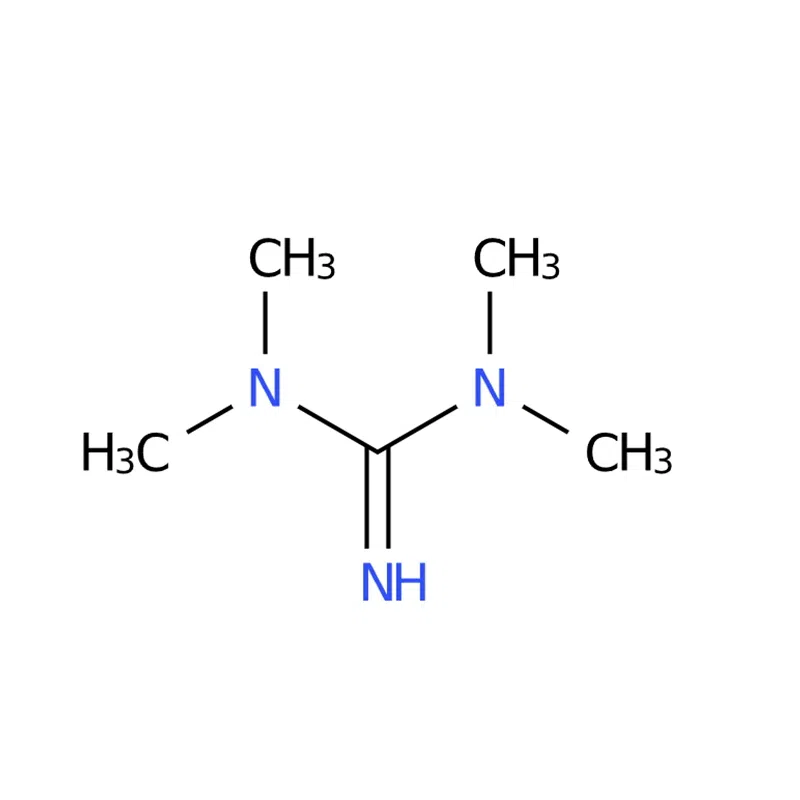
Products Description
Tetramethylguanidine (TMG) is a potent organic base catalyst with broad industrial applications. It is frequently adopted as a co-solvent in the synthesis of novel cephalosporin antibiotics.
Moreover, TMG can act as a catalyst for manufacturing polyurethane foams. It is also applied in the level-dyeing process of nylon, wool and other protein-based fibers, which improves dye distribution uniformity and boosts the durability of textile materials.
Chemical Properties
| Melting point | -30 °C |
| Boiling point | 162-163 °C (lit.) |
| Density | 0.916 g/mL at 20 °C (lit.) |
| Vapor pressure | 0.2 mm Hg ( 20 °C) |
| Refractive index | n20/D 1.469 |
| Fp | 140 °F |
| Storage temp | Store below +30°C. |
| Solubility | Acetonitrile (Slightly), DMSO (Slightly), Methanol (Slightly) |
| Pka | 15.20±0.70(Predicted) |
| Form | Liquid |
| Color | APHA: ≤150 |
| PH | 12.7 (10g/l, H2O, 25℃) |
| Relative polarity | 5.5 |
| Odor | mild ammoniacal odor |
| Explosive limit | 1.0-7.5%(V) |
| Water Solubility | miscible |
| Sensitive | Air Sensitive |
| BRN | 969608 |
| Dielectric constant | 23.1 |
| Stability | Stable. Combustible. Incompatible with strong oxidizing agents, mineral and organic acids, carbon dioxide. Air-sensitive. |
| InChIKey | KYVBNYUBXIEUFW-UHFFFAOYSA-N |
| LogP | -0.49 at 20℃ |
| CAS DataBase Reference | 80-70-6(CAS DataBase Reference) |
| NIST Chemistry Reference | N,N,N',N'-Tetramethylguanidine(80-70-6) |
| EPA Substance Registry System | Guanidine, N,N,N',N'-tetramethyl- (80-70-6) |
Safety Information
| Hazard Codes | C |
| Risk Statements | 22-34-20/22-10 |
| Safety Statements | 26-27-36/37/39-45-16 |
| RIDADR | UN 2920 8/PG 2 |
| WGK Germany | 1 |
| F | 46288 |
| Autoignition Temperature | 222 °C |
| Hazard Note | Harmful/Corrosive |
| TSCA | Yes |
| HazardClass | 8 |
| PackingGroup | II |
| HS Code | 29252000 |
| Toxicity | LD50 orally in Rabbit: 835 mg/kg |
Product Application
Tetramethylguanidine is extensively used as a high-strength organic base catalyst and co-solvent for synthesizing novel antibiotics, especially cephalosporin-type medicines. It also acts as a catalyst in the manufacture of polyurethane foam. Within the textile sector, it is utilized for the level dyeing of nylon, wool and other protein-based fibers to achieve even dye distribution and strengthen wool durability. Furthermore, it is primarily applied in the synthesis of pharmaceutical ingredients including cefradine.