
Product Details
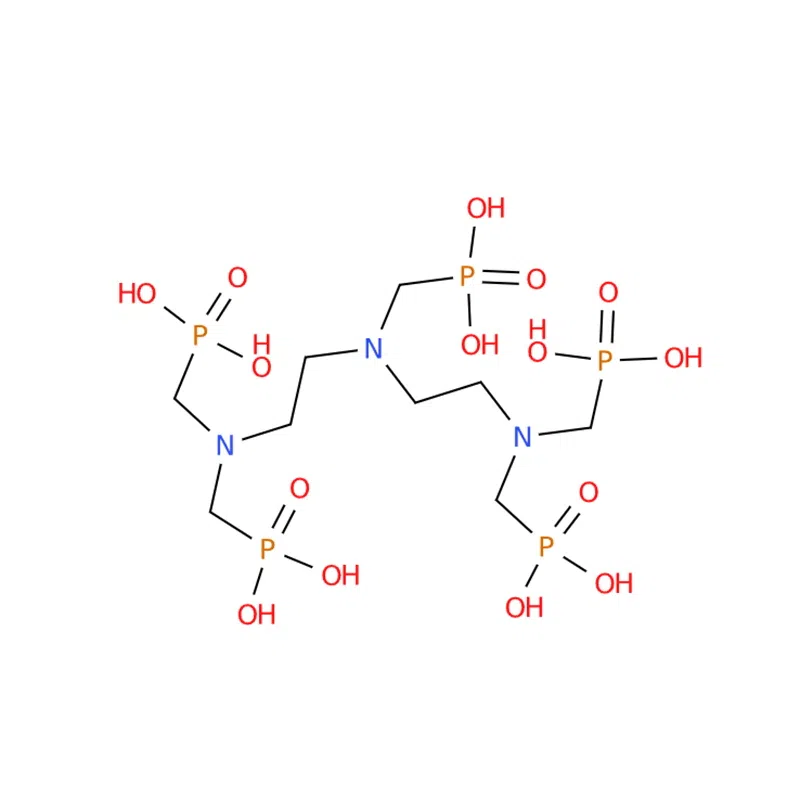
Diethylenetriamine pentamethylene phosphonic acid is a commonly applied corrosion and scale inhibitor. It is a non-toxic, brown or reddish-brown viscous liquid, with the molecular formula C₉H₂₈O₁₅N₃P₅ and a relative molecular mass of 573.2.
Soluble in acidic media, it forms multi-ring complexes with iron ions from steel in aqueous systems. It disperses well in water and hinders the crystallization of calcium salts including carbonates and sulfates, thus effectively inhibiting scale buildup. It can also prevent carbonate and sulfate scale deposition across multiple industrial applications.

Parameters
| Boiling point | 1003.3±75.0 °C(Predicted) |
| density | 1.35 (50% aq.) |
| vapor pressure | 0Pa at 25℃ |
| storage temp. | Hygroscopic, -20°C Freezer, Under inert atmosphere |
| solubility | Aqueous Base (Sparingly), Water |
| form | Oil |
| pka | 0.59±0.10(Predicted) |
| color | Pale Yellow to Brown |
| Water Solubility | 500g/L at 25℃ |
| BRN | 2068968 |
| InChIKey | DUYCTCQXNHFCSJ-UHFFFAOYSA-N |
| SMILES | P(=O)(O)(O)CN(CCN(CCN(CP(=O)(O)O)CP(=O)(O)O)CP(=O)(O)O)CP(=O)(O)O |
| LogP | -3.4 |
| CAS DataBase Reference | 15827-60-8(CAS DataBase Reference) |
| EPA Substance Registry System | Phosphonic acid, [[(phosphonomethyl)imino]bis[2,1-ethanediylnitrilobis(methylene)]]tetrakis- (15827-60-8) |
Safety Information
| Hazard Codes | Xi,C |
| Risk Statements | 36/37/38-51/53-41-37/38 |
| Safety Statements | 26-36-33-28-23-16-9-39 |
| RIDADR | UN 1789 8/PG 2 |
| WGK Germany | - |
Diethylenetriaminepenta(methylenephosphonic acid), a type of phosphonate compound, is categorized as a wastewater pollutant and serves as an essential building block for phosphorus-containing nanoparticles and functional materials. For instance, it is utilized in synthesizing chitosan nanoparticles designed for pulmonary decorporation of plutonium.
Aqueous solutions of this compound are suitable for researching the crystallization dynamics and reaction kinetics of sodium sulfate in systems containing different organophosphonic acids. Additionally, it can act as a ligand to characterize Ce³⁺ complexes using luminescence spectroscopy techniques.