
Products Description of Collagenase CAS#9001-12-1
Collagenase, alternatively known as clostridial peptidase, is a proteolytic enzyme generated via fermentation of Clostridium histolyticum.
Medical-grade collagenase is isolated and purified from the culture supernatant of Clostridium histolyticum strain ATCC 21000, and exhibits potent catalytic activity against peptide bonds featuring the Gly-Pro sequence.
By breaking down native collagen molecules, it creates a permissive microenvironment for other proteolytic enzymes, endowing it with a distinctive capacity to hydrolyze and denature collagen simultaneously.
This pharmaceutical-grade collagenase effectively degrades both native and denatured collagen, exerts pronounced degradative effects on necrotic tissue, and stimulates granulation tissue formation alongside epithelial cell proliferation.
It shows no activity toward globulins or fibrin, thus sparing intact blood vessels and muscle tissue from damage. Accordingly, it is broadly applied for wound debridement, eschar removal, and clinical management of chronic cutaneous ulcers, pressure injuries, as well as second- and third-degree burns.
Collagenase Chemical Properties
| Storage temp | -20°C |
| Solubility | Soluble in aqueous buffers. |
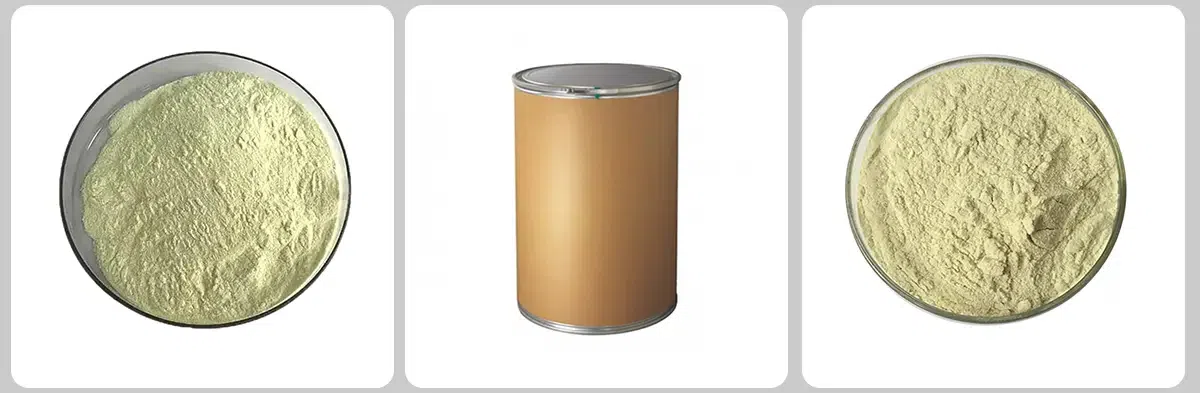
| Form | powder |
| Color | light brown |
| PH | 7 |
| Merck | 2481 |
| InChIKey | YRQNKMKHABXEJZ-UVQQGXFZSA-N |
| CAS DataBase Reference | 9001/12/1 |
| EPA Substance Registry System | Collagenase (9001-12-1) |
| Hazard Codes | Xn |
| Risk Statements | 36/37/38-42 |
| Safety Statements | 22-24-26-36/37 |
| WGK Germany | 1 |
| F | 10-21 |
| HS Code | 3507907000 |
Product Application of Collagenase CAS#9001-12-1
Revised Academic Style English Version
Collagen plays an indispensable role in wound repair and scar development. As a core constituent of elastic tissues and adhesive matrices, it accelerates cell proliferation and differentiation, facilitates tissue maturation, and drives connective tissue hyperplasia. Moreover, collagen boosts capillary regeneration, triggers chemotactic migration of monocytes and fibroblasts, and modulates the nutrition and remodeling of granulation tissue. Research has verified that collagen can treat various types of cutaneous ulcers by promoting re-epithelialization of superficial and deep ulcerated regions and stimulating granulation tissue generation.
Role in Maintaining Bone Architecture and Mechanical Strength
Collagen accounts for roughly 70–80% of the organic fraction of bone tissue. During osteogenesis, collagen fibrils are synthesized first to build the skeletal scaffold of bone, earning collagen the moniker “bone inside bone”. These fibrils endow bone with tensile strength, pliability and resilience. Analogous to steel rebar reinforcing concrete pillars, collagen fibrils structurally strengthen bones. A collagen deficiency is equivalent to using substandard reinforcing steel, markedly elevating the susceptibility to bone fractures.
Structural Support for Breast Tissue
Collagen has long been acknowledged for its function in sustaining breast structure. Mammary tissue is predominantly composed of connective and adipose tissue, whose firmness and contour are largely determined by the integrity of connective tissue. As the major component of connective tissue, collagen cross-links with proteoglycans to form a three dimensional network. This network provides mechanical stability, supports bodily contours and preserves breast tone.
Protective and Elastic Properties in the Skin
Commonly summarized as “bone within bone, skin within skin, flesh within flesh”, collagen forms the structural backbone of the dermis. With a thickness of around 2 mm, the dermis comprises the papillary, subpapillary and reticular layers, and is mainly constituted by proteins dominated by collagen and elastin, with collagen making up approximately 70% of skin tissue. Functioning as a bodily protective barrier, collagen allows the skin to tolerate physical movement while sustaining proper elasticity, firmness and defensive capacity.