
Product Details
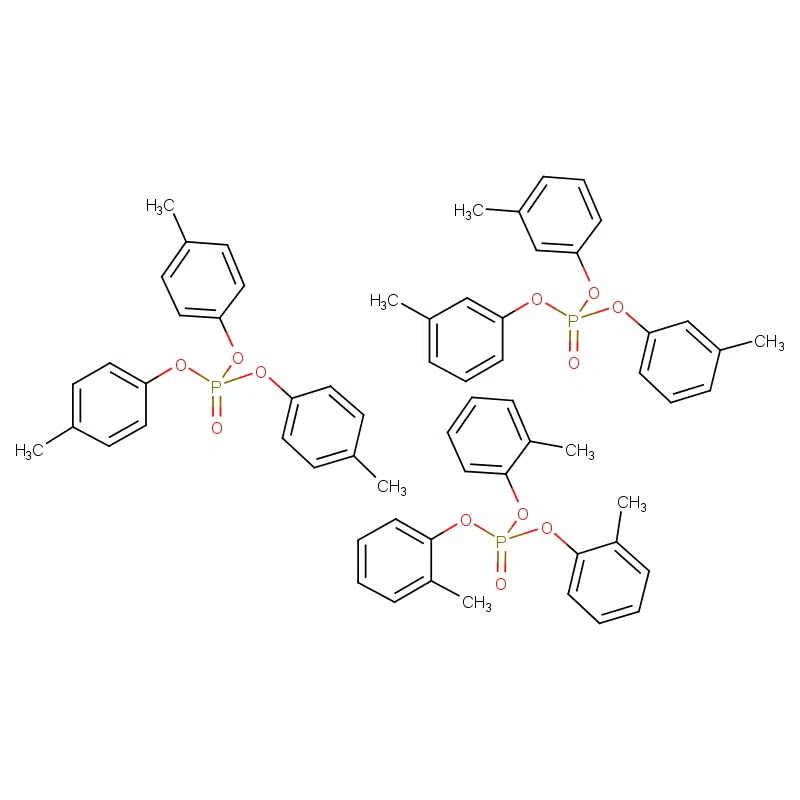
Tricresyl phosphate (TCP) is a chemical blend with a mildly sharp odor. It comprises three isomers: the ortho and meta-isomers are liquids, whereas the para-isomer is a crystalline solid. TCP is synthesized by reacting cresol with phosphorus oxychloride in the presence of an aluminum-based catalyst.
It serves to extract residual phenol from gas-plant wastewater and functions as a plasticizer within the plastics sector. As a plasticizer, TCP improves the flexibility, hardness, water resistance and flame-retardant properties of polymer materials; up to 50% TCP may be incorporated into polyvinyl chloride (PVC). Nevertheless, TCP poses toxic risks to humans and animals. Exposure via ingestion, inhalation or dermal absorption can trigger neuropathy, paralysis and even fatal outcomes.
Parameters
| Melting point | <-40°C |
| Boiling point | 265 °C10 mm Hg(lit.) |
| Density | 1.143 g/mL at 25 °C(lit.) |
| Pour Point | -28 |
| Vapor pressure | 0.03 mm Hg ( 25 °C) |
| Refractive index | n20/D 1.555(lit.) |
| Fp | >230 °F |
| Storage temp. | Store below +30°C. |
| Solubility | organic solvents: miscible(lit.) |
| Form | Powder |
| Color | White to off-white |
| Water Solubility | INSOLUBLE |
| Merck | 14,9763 |
| Dielectric constant | 4.0(80℃) |
| Stability | Stable. Incompatible with strong oxidizing agents. May soften some plastics. Hydrolyzes slowly under alkaline conditions. |
| InChIKey | ISNNXHQBIBWQHG-UHFFFAOYSA-N |
| LogP | 5.93 |
| Surface tension | 40.9mN/m at 20°C |
| CAS DataBase Reference | 1330-78-5(CAS DataBase Reference) |
| EPA Substance Registry System | Tricresyl phosphate (1330-78-5) |
Safety Information
| Hazard Codes | Xn,N,T |
| Risk Statements | 21/22-51/53-39/23/24/25-62-50/53 |
| Safety Statements | 28-61-45-28A-20/21-60-36/37 |
| RIDADR | UN 2574 6.1/PG 2 |
| WGK Germany | 2 |
| RTECS | TD0175000 |
Autoignition Temperature | 770 °F |
| TSCA | Yes |
| HS Code | 2919 90 00 |
| HazardClass | 6.1 |
| PackingGroup | II |
Hazardous Substances Data | 1330-78-5(Hazardous Substances Data) |
| Toxicity | cat,LD50,skin,1500mg/kg (1500mg/kg),BEHAVIORAL: ATAXIAPERIPHERAL NERVE AND SENSATION: FLACCID PARALYSIS WITHOUT ANESTHESIA (USUALLY NEUROMUSCULAR BLOCKAGE),Toxicology Letters. Vol. 1000(Sp, |
Product Application
Tricresyl phosphate is applied in the manufacture of vinyl-based plastics as a plasticizer, flame retardant, and nitrocellulose solvent. It is also incorporated into cellulosic molding compositions, formulated as an additive for extreme-pressure lubricants, and used as a non-combustible hydraulic fluid.
Furthermore, it acts as a lead-removing agent in gasoline and has been utilized for sterilizing certain surgical instruments, as documented in the patent Yust, Bame, US 2889212 (assigned to Shell in 1959).