
Products Description
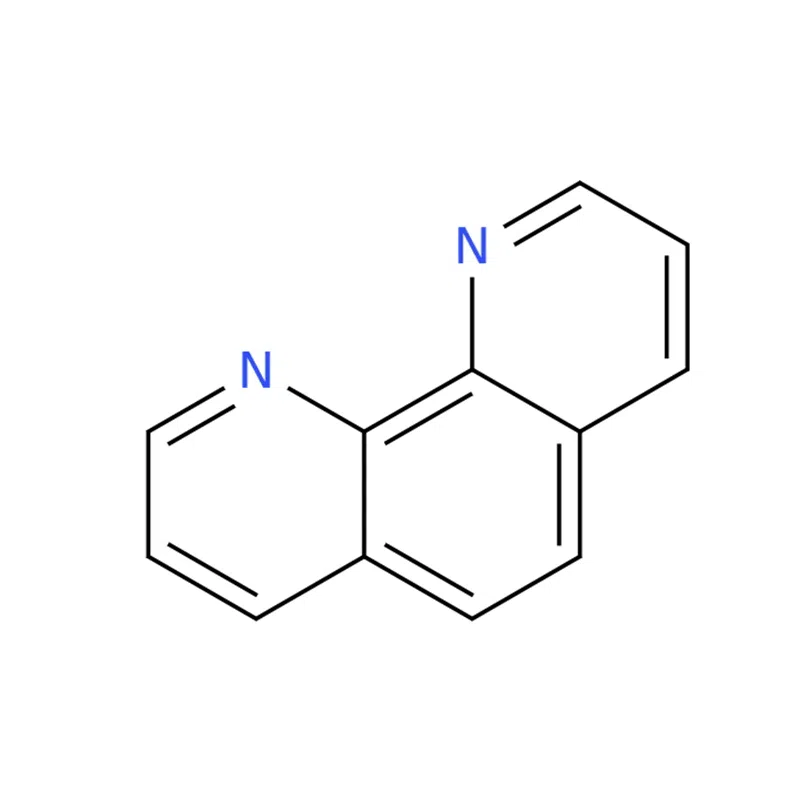
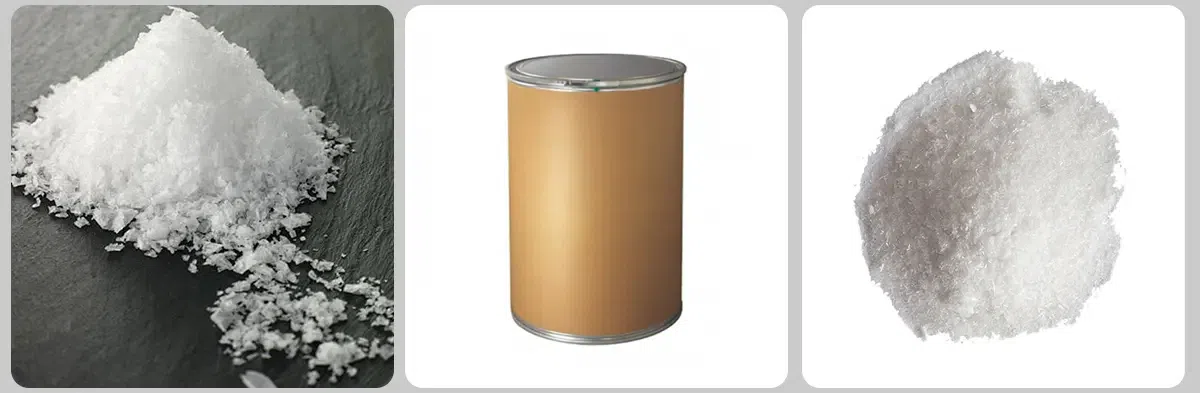
1,10-Phenanthroline monohydrate is an organic intermediate occurring as a white crystalline powder. It is widely employed as a redox indicator and an analytical reagent for quantifying metal ions including ferrous iron, palladium, vanadium, copper and iron.
The monohydrate has a density of 1.10 and melts at 93–94 °C, whereas its anhydrous counterpart has a melting point of 117 °C. It dissolves in approximately 300 parts of water and 70 parts of benzene, and is also soluble in ethanol and acetone. However, it is insoluble in petroleum ether.
Chemical Properties
| Melting point | 114-117 °C(lit.) |
| Boiling point | >330°C |
| Density | 1.1836 (rough estimate) |
| Refractive index | 1.5200 (estimate) |
| Fp | >330°C |
| Storage temp | Store below +30°C. |
| Solubility | 2.69g/l |
| Pka | 4.84(at 25℃) |
| Form | Powder |
| Color | White to light yellow or light pink |
| Water Solubility | slightly soluble |
| Sensitive | Hygroscopic |
| Merck | 147214 |
| BRN | 126461 |
| Stability | Stable. Hygroscopic. Store under nitrogen. Incompatible with strong acids, strong oxidizing agents. |
| InChIKey | DGEZNRSVGBDHLK-UHFFFAOYSA-N |
| CAS DataBase Reference | 66-71-7(CAS DataBase Reference) |
| NIST Chemistry Reference | o-Phenanthroline(66-71-7) |
| EPA Substance Registry System | 1,10-Phenanthroline (66-71-7) |
Safety Information
| Hazard Codes | T,N |
| Risk Statements | 25-50/53 |
| Safety Statements | 45-60-61 |
| RIDADR | UN 2811 6.1/PG 3 |
| WGK Germany | 3 |
| RTECS | SF8437000 |
| TSCA | Yes |
| HazardClass | 6.1 |
| PackingGroup | III |
| HS Code | 29339990 |
| Toxicity | dni-hmn:leu 5 mg/L ONCOBS 46,193,89 |
Product Application
1,10-Phenanthroline is a commonly utilized ligand for the spectrometric analysis of metals and spectroscopic research into CO₂ reduction. It also participates in Cu(II)-catalyzed cross-linking reactions of organic boric acids, and acts as a redox indicator as well as an analytical reagent for titanium and iron quantification.
This compound readily forms coordination complexes with metal ions including iron, copper, cobalt and nickel, and can interact with 2,2′-bipyridine. Notably, it generates a red-colored complex withFe²⁺. Upon oxidation by potassium permanganate, it converts into 2,2′-dipyridyl-3,3′-dicarboxylic acid. Moreover, it serves as a quantitative colorimetric reagent for copper and iron, and functions as an indicator during the titration of iron salts with cerium sulfate.