
Products Description
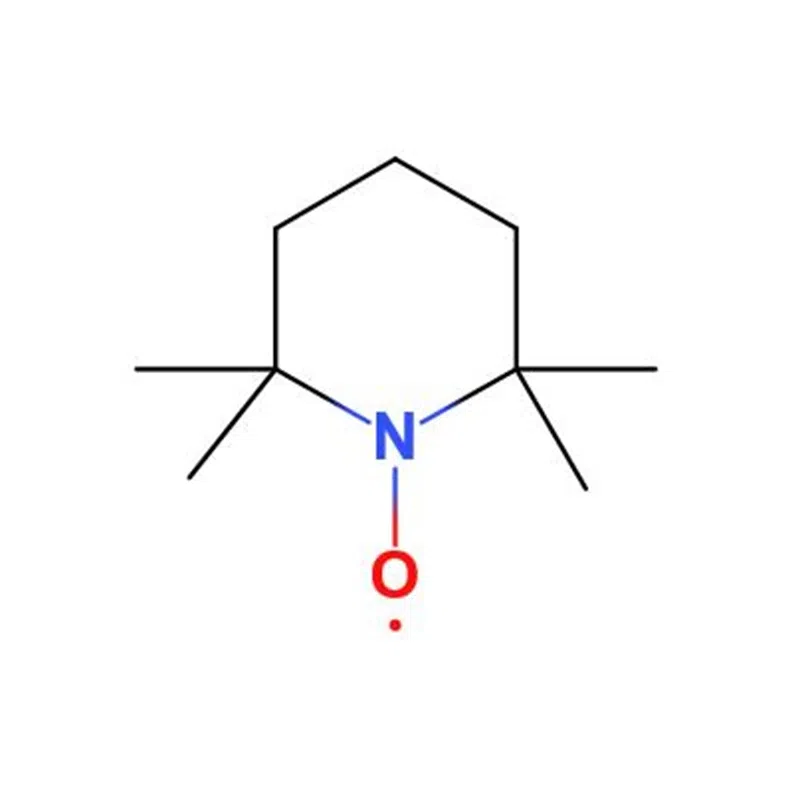
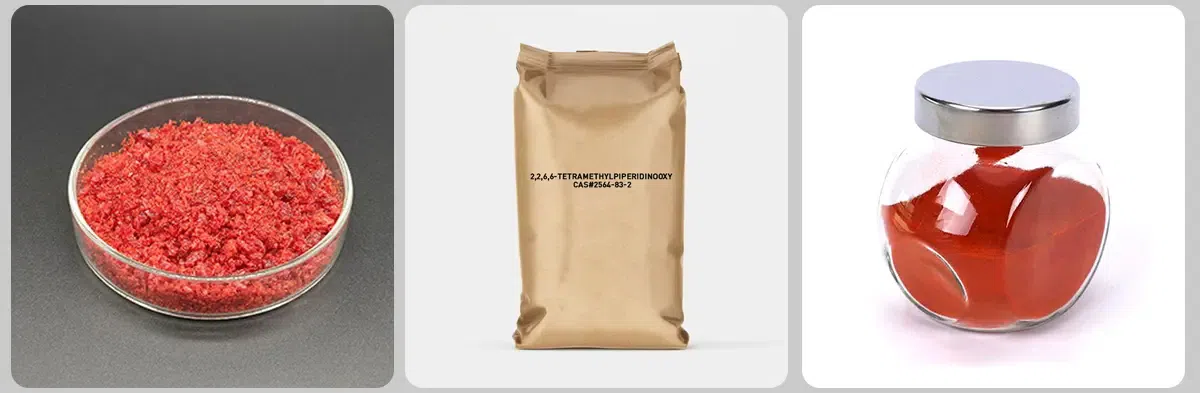
2,2,6,6-Tetramethylpiperidin-1-oxyl, widely known by its short form name TEMPO, is a nitroxide-type free radical derived from piperidine. It occurs as orange-red crystals or liquid with notable sublimability, and shows good solubility in common solvents including water, ethanol and benzene.
TEMPO demonstrates outstanding performance in scavenging free radicals and quenching singlet oxygen. Moreover, it acts as a high efficiency oxidation catalyst, enabling the selective oxidation of primary alcohols to aldehydes and secondary alcohols to ketones.
Chemical Properties
| Melting point | 36-38 °C(lit.) |
| Boiling point | 193°C |
| Density | 1 g/cm3 |
| Vapor pressure | 0.4 hPa (20 °C) |
| Refractive index | 1.4350 (estimate) |
| Fp | 154 °F |
| Storage temp | Store below +30°C. |
| Solubility | 9.7g/l |
| Form | Powder |
| Color | Yellow to green |
| PH | 8.3 (9g/l, H2O, 20℃) |
| Water Solubility | Soluble in all organic solvents. Insoluble in water. |
| Merck | 149140 |
| BRN | 1422418 |
| Stability: | Stable. Incompatible with strong acids, strong oxidizing agents. Refrigerate. |
| InChIKey | RVWUHFFPEOKYLB-UHFFFAOYSA-N |
| CAS DataBase Reference | 2564-83-2(CAS DataBase Reference) |
| NIST Chemistry Reference | 1-Piperidinyloxy, 2,2,6,6-tetramethyl-(2564-83-2) |
| EPA Substance Registry System | 1-Piperidinyloxy, 2,2,6,6-tetramethyl- (2564-83-2) |
Safety Information
| Hazard Codes | C,Xi |
| Risk Statements | 34-36/37/38 |
| Safety Statements | 26-36/37/39-45-24/25 |
| RIDADR | UN 3263 8/PG 2 |
| WGK Germany | 3 |
| RTECS | TN8991900 |
| Autoignition Temperature | 275 °C |
| TSCA | Yes |
| HazardClass | 8 |
| PackingGroup | III |
| HS Code | 29333999 |
Product Application
TEMPO finds extensive applications across chemistry, biology, the food industry, agriculture and numerous other sectors, acting as a free-radical scavenger, singlet-oxygen quencher and selective oxidation catalyst.
Within polymer chemistry, it serves as a free-radical scavenger, polymerization inhibitor, anti-aging additive, thermal degradation inhibitor, as well as a light and heat stabilizer. It can react with reactive chain radicals to generate covalently bonded dormant species, which may subsequently dissociate back into chain radicals to sustain chain-growth polymerization.
In organic synthesis, TEMPO is commonly employed as a catalyst for oxidizing diverse alcohols and polyols. It selectively converts primary alcohols into aldehydes without further oxidizing them to carboxylic acids, whereas secondary alcohols are oxidized into ketones. The TEMPO/NaClO/NaBr system represents a recyclable oxidation system, where the real oxidizing agent is the N-oxoammonium ion produced from TEMPO oxidation by NaClO. During this cyclic process, hydroxyl groups are oxidized while TEMPO is regenerated by the co-oxidant, enabling continuous and efficient oxidation. Furthermore, a variety of other TEMPO-based oxidation systems are widely adopted in synthetic chemistry.